Fertility Blog by Our Tbilisi, Georgia IVF Specialists #3

Anyone who searches for suggested IVF centers soon discovers that a recommendation can mean many things. It may be a list on a website, a friend's experience, a forum thread, an agency offer or a doctor's referral. Each source has strengths and weaknesses, and none replaces your own careful checking. This guide explains how to find and evaluate a Georgia IVF center, what makes a centre worth suggesting, how clinics in Tbilisi and Batumi differ, which questions to ask about the clinic and the partner hospital, which warning signs to avoid and how to compare your shortlist fairly. It does not rank or name individual clinics, because rankings can be outdated or influenced by advertising, and every family has different medical needs. The text is general information, not medical or legal advice.

A surrogacy center is an organisation that brings together the medical, legal, psychological and practical services needed for a surrogacy journey. Families who search for a Georgia IVF center with a surrogacy programme want to know what happens inside such a place, who works there, how surrogates are selected and cared for, how intended parents are supported and which signs separate a reliable centre from a risky one. This guide explains the structure of a surrogacy center, the role of each team, the standards to look for in a clinic and hospital in Tbilisi or Batumi and the questions to ask before you commit. It is general information, not medical or legal advice, and every family should confirm the details with a specialist doctor and a Georgian lawyer.

What Sperm Donation Prices Depend On
Many individuals and couples who are considering building a family with donor sperm start their research with the same question: how much does sperm donation cost? This question cannot be answered with a single figure, because sperm donation is not one product. It is the shared name for treatment paths with very different cost structures. The cost gap between a simple insemination using donor sperm and an IVF cycle with ovarian stimulation and donor sperm can be many times over.

Sperm donation is one of the oldest and best established forms of third party reproduction. It helps men who have no sperm or very poor sperm quality, couples who carry certain genetic risks and, where the law allows, women who wish to conceive without a male partner. People who search for a Georgia IVF center often ask whether donor sperm is available, how donors are screened, what the legal position is and how the treatment works in clinics in Tbilisi and Batumi. This guide answers those questions in plain language. It explains who may need donor sperm, how donors are recruited and tested, which treatments use donor sperm, what published legal commentary says about parentage and privacy in Georgia, how to compare clinics and how to prepare emotionally. It is general information, not medical or legal advice, and every plan should be confirmed with a specialist doctor and a Georgian lawyer.

Preimplantation genetic diagnosis, usually shortened to PGD, is a laboratory method that tests embryos created through in vitro fertilisation for a specific inherited condition before one is transferred to the uterus. When the condition is caused by a change in a single gene, the technique is often called preimplantation genetic testing for monogenic disorders, or PGT M. Families who carry a serious inherited disease may search for a Georgia IVF center that can offer this option, and they often ask how the test works, how long preparation takes, how accurate it is and what to look for in a clinic and hospital in Tbilisi or Batumi. This guide explains the science, the steps, the limits and the practical questions in plain language. It is general information, not medical advice, and every family should discuss their own case with a clinical geneticist and a fertility specialist.
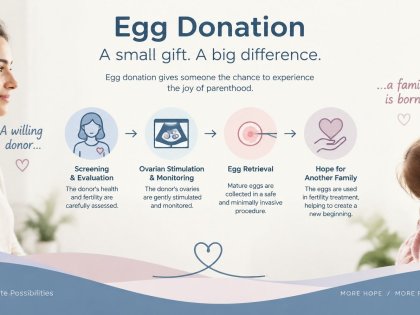
Many women and couples around the world reach a point where their own eggs can no longer offer a realistic path to a baby. Age, early menopause, diminished ovarian reserve, repeated failed cycles, genetic concerns or earlier cancer treatment can all close that door. For these families, becoming pregnant with egg donation is often the most reliable and emotionally rewarding option, and Georgia has become one of the most talked about destinations for it. A modern Georgia IVF center offers experienced doctors, a large donor pool, short waiting times and a legal framework that supports patients. In this guide you will learn how egg donation works, what to expect at a clinic or hospital in Tbilisi or Batumi, how the treatment is timed, what it costs in broad terms and how to prepare for travel and treatment.

A Number With a Lot of Hope Attached
Few ideas in reproductive medicine have attracted as much curiosity in recent years as the measurement of mitochondrial DNA in embryos. The appeal is easy to understand. After a failed transfer, or after a long search for an embryo that looks healthy, patients and doctors alike would love a single, objective number that says which embryo will implant. A laboratory score that appears to read an embryo’s energy status sounds like exactly that. It is therefore not surprising that some clinics describe mitochondrial DNA measurement as an advanced add on, and that patients ask about it by name.

The Question Behind the Question
When people ask about the prices of an IVF center, they usually type a short question into a search box: how much does it cost? It is a fair question, and it deserves a direct answer. The difficulty is that the question hides several others. How much for what, exactly? For one cycle or for the whole journey? With medication or without? With storage or without? And, underneath all of it, what is the chance that this money will be enough?

A Name on a Brochure
Sooner or later, almost every fertility patient meets a test with a name that sounds scientific and a promise that sounds hopeful. It might be a panel of gene names, a number, an acronym and a phrase such as gene expression. The brochure says it can reveal something your other tests cannot: whether your tissue is ready, whether an embryo is likely to work, or why earlier cycles failed. You are tired, you have invested a lot, and you would like to believe it.

People who consider surrogacy often carry a quiet question alongside the medical and legal ones: is it a sin? The question matters deeply to believers, and it also matters to people who are not religious but want to be sure that what they do is ethical. There is no single answer that every tradition accepts. Religious authorities, scholars and ordinary believers disagree, and many traditions have more than one voice on the subject. This guide does not give a personal verdict. It explains how different traditions and ethical schools approach surrogacy, what arguments each side makes, which questions believers usually ask and how families who consider treatment at a Georgia IVF center in Tbilisi or Batumi can reflect with care before they decide. It is general information, not religious, legal or medical advice, and anyone who wants a binding answer for their own faith should speak with a trusted religious authority.

A Question Asked Quietly
Many of the people who type this question into a search bar have already lived through a great deal. They have waited, tried, grieved and hoped. Often they have been told by a doctor that their own eggs are unlikely to lead to a pregnancy, and that donor eggs are the realistic option. For a Muslim woman or couple, that medical advice arrives together with a second question that no doctor can answer: is this permitted in my faith? The word they use is haram, and it carries enormous weight. It means forbidden, and for a believer, it touches conscience, family and the relationship with God.

Where Is Surrogacy Legal
Surrogacy is one of the most unevenly regulated reproductive health practices in the world. A method that is fully permitted in one country can be a crime in the neighboring one. On top of that, a country allowing surrogacy does not mean the child born there will be recognized as your legal child in your own country. For this reason, the answer to "where is surrogacy legal" requires looking at both the country where treatment takes place and the country where you hold citizenship.

Why a Club Needs a Charter
Women who go through fertility treatment often say the same thing: the hardest part is not the injections. It is the loneliness. Friends may not understand, family may ask the wrong questions, and the clinic, however kind, is a place of appointments and procedures. So women look for each other. They join online groups, message circles, meetups, patient associations and what many call a women’s club, a space where people on the same road can speak freely.

One Question, Many Answers
People ask whether egg donation is religiously permissible in many languages and from within many traditions. The person asking might be a devout believer who wants to be sure that a medical path will not violate conscience. She might be a spouse worried about a partner’s faith. She might be a grandparent who has just been told that the baby they are hoping for would be conceived with a donor’s egg. She might simply be a person whose beliefs are not tied to one tradition but who feels that a decision this large deserves moral reflection.

Not every family can build a baby with its own eggs, sperm and womb. Age, illness, genetic risk, repeated treatment failure or the absence of a partner can make a standard IVF cycle unrealistic. In these situations, third party reproduction offers medical options that were unimaginable a few decades ago. Egg donation, sperm donation, embryo donation and surrogate motherhood are the four main routes, and each one answers a different medical or personal need.
- «
- ‹
- 3 / 6
- ›
- »